

News - China's exports grew by 5.9% in November, while shipments to the United States fell by 29%.
Business Strategy
China's exports grew by 5.9% in November, while shipments to the United States fell by 29%.
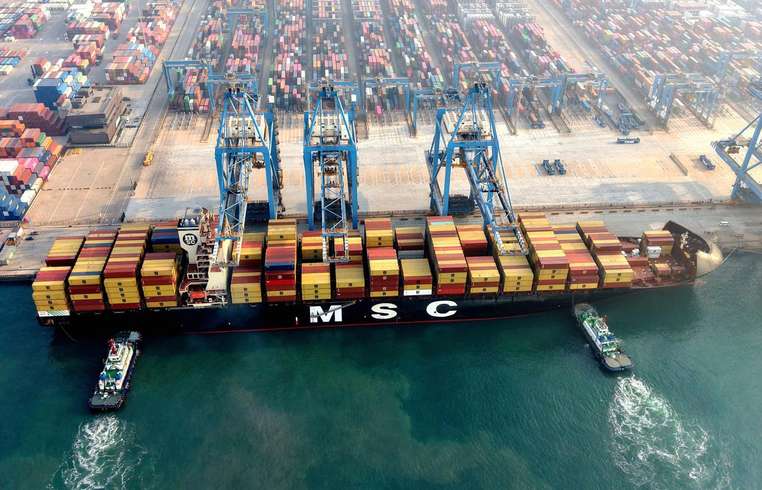
By Chan Ho-Him HONG KONG (AP) — China's exports rebounded in November after an unexpected contraction the month before, although shipments to the United States fell about 29% from a year earlier, marking the eighth consecutive month of double-digit declines. China's total exports in November were 5.9% higher than a year earlier in dollar terms, according to customs data released Monday, reaching $330.3 billion, beating economists' estimates. This represents an improvement from the 1.1% contraction in October. Highlighting a widening gap between total exports and imports, customs data showed that China's trade surplus for the first 11 months exceeded the $1 trillion mark, reaching nearly $1.08 trillion. This is a record for any year and surpasses the $992 billion surplus for all of 2024, according to official data compiled by FactSet. Although China's exports to the United States have fallen for much of the year, shipments have risen to other destinations, including Southeast Asia, Latin America, Africa, and the European Union. China's imports rose 1.9% in November, topping $218.6 billion, better than October's 1% growth, though a persistent slowdown in the housing sector continues to weigh on consumer spending and business investment. By the end of October, a one-year trade truce between China and the United States was reached at a meeting between U.S. President Donald Trump and Chinese leader Xi Jinping in South Korea. The United States has reduced its tariffs on China, and China has pledged to halt its export controls related to rare earths. "It is likely that November exports have not yet fully reflected the tariff cuts, which should show up in the coming months," wrote Lynn Song, chief economist for ING Bank for Greater China, in a note. China's factory activity contracted for the eighth consecutive month in November, according to an official survey, and economists said it was still early to determine whether there will be a genuine rebound in external demand after the U.S.-China trade truce. With exports still strong, economists generally expect China to meet or roughly meet its growth target of around 5% for this year. Chinese leaders had outlined a focus on advanced manufacturing for the next five years following a high-level meeting in October. On Monday, an annual economic planning meeting led by Xi was held to map growth plans for 2026, according to the state news agency Xinhua, as Chinese leaders reiterated a focus on pursuing progress while ensuring stability. Chi Lo, global market strategist at BNP Paribas Asset Management, said that a stable global trade environment is unlikely to last long, as relations between China and the United States remain deadlocked despite the temporary trade truce. Still, some economists believe China will continue to gain share of export markets in the coming years. Morgan Stanley predicts that by 2030, China's share of global exports will reach 16.5%, up from about 15% currently, driven by its advantage in advanced manufacturing and high-growth sectors such as electric vehicles, robotics, and batteries. Chetan Ahya, Asia chief economist at Morgan Stanley, noted in a recent report that despite persistent trade tensions, ongoing protectionism and G20 economies adopting active industrial policies, we believe that China will gain more share in the global export of goods. This story was translated from English by an AP editor with the help of a generative AI tool.
About usyoo

Categories
Tags