
News - We are confident that the tax revenues of the 2025 state budget will be 133% higher than the tax revenues of 2017. Pashinyan
Business Strategy
We are confident that the tax revenues of the 2025 state budget will be 133% higher than the tax revenues of 2017. Pashinyan
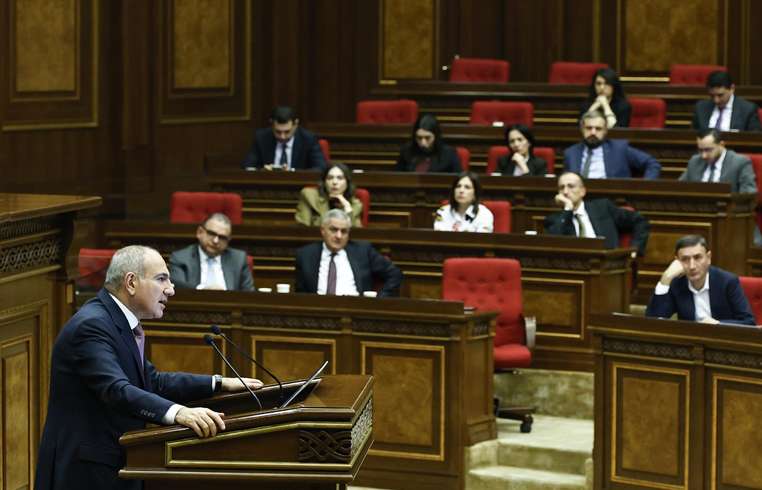
Prime Minister Nikol Pashinyan delivered his closing speech during the discussion in the National Assembly of the draft law On Armenia’s 2026 State Budget. We present it below. We discussed the 2026 state budget draft. Of course, the Minister of Finance and the deputies addressed numerous questions during these two-stage discussions, but there is also a through line that this is essentially the final budget discussion in this National Assembly, because the next budget discussion will take place in the next convocation of the National Assembly. And I think and feel compelled to give one or two assessments of the budget discussions that are currently underway or have taken place. In summary, I want to say that I generally evaluate the work of this current convocation of the National Assembly as good and I am satisfied with the government’s work; of course I do not rate it as excellent, but as good. Now I want to explain why I rate it as good. December is indeed upon us, the budget year is not yet over, but we have confident forecasts for 2025 tax revenues: we are confident that 2025 state budget tax revenues will be higher than those of the 2017 state budget by 1 trillion 542 billion drams or 133%. I want to highlight this nuance for your attention: this year’s increased allocation of our budget is higher than 2017’s total budget. In other words, our increased portion exceeds 2017’s annual budget. Why compare with 2017? Because in the second half of 2018 the budgeting logic changed, though compared with 2018 our budget revenues have also grown. In 2021, during the parliamentary elections, we promised to ensure an average annual economic growth of 7%. This promise has been fully fulfilled, because we are confident that over five years the minimum scenario is 7.5, 7.6% growth; realistically growth will be higher at the median. From 2021 to 2024, Armenia’s gross domestic product grew by 36.6%. This is a very good figure. Now, this issue is constantly discussed: you say you talk about budget growth and economic growth, wages, job creation, etc., but how has this affected people’s lives? You may recall that during committee discussions I addressed this question, and I want to answer it based on expert conclusions: our economists have suggested that the answer could be given by the so-called Gini coefficient, which shows how income generated in the country is distributed among the population. And according to the latest figures, Armenia has significantly improved in this regard, and compared with the preceding period we have a fairly good improvement, meaning that the distribution of money produced and the results is as fair and as equal as possible and is improving. By the way, today, as I was preparing for this speech, I again turned to the Gini coefficient and my eye was drawn to the following: I wanted to understand whether this indicator is historically the best in Armenia’s history or not, and you know what turned out: historically the best value of the Gini coefficient for Armenia was in 2020. What does this mean? It means that the harsh criticisms of COVID crisis management were simply unfounded. We won the 2018 elections under the slogan Caring Society, and in 2020 the Gini coefficient shows that our government pursued exactly that strategy. And in 2020 the country’s results were distributed as evenly as possible, which means that during the crisis we provided citizens with more targeted support. Now I want to address other indicators: the number of jobs. This year, in October, we again recorded an absolute record of registered and salaried jobs. By October 2025 we have 810,074 registered jobs in the country. The increase since 2018 was 223,895 jobs, or 38%. Honorable colleagues, this shows that since 2018 we have created 223,895 jobs in Armenia. This is a figure that has never been seen in Armenia’s history for such a period. Moreover, this growth is ongoing: compared to October 2024, 31,000 jobs were created, or 4%. The average wage by October is 313,000 drams, up 135,657 drams or 76% since 2018. We talk a lot about inflation; there has not been a 76% inflation in Armenia, and in real terms our wage growth is double-digit at 20% or more, which shows the level of citizens’ welfare. The income tax paid in October was 50.699 billion drams, which is almost double the figure of October 2018 — up 95% or plus 24 billion drams. Now what do these numbers have to do with citizens’ welfare? They relate to the extent that since 2018 through 2025 we have returned to Armenian citizens, through income tax, 384 billion drams; money given back to citizens. Moreover, there has been a 9,500% increase in the return of income tax compared with the preceding period. I also compared 2010–2017 with 2018–2025: real estate transactions for houses bought by people have grown by more than 67,000, or 64%. In the regions the primary market grew by 1,104% relative to the preceding period. I want to demonstrate territorial balanced development: overall, the primary market’s growth in 2018–2025 compared to 2010–2017 is 465%. All this shows that Armenia is on a path of development. Is there a social and poverty problem in Armenia? Yes, there is a social and poverty problem. Recently poverty rates were published; in our assessment, they are fairly good indicators, but methodological questions still need to be refined. But one thing is evident: extreme poverty is 0.6% regardless of methodology; this means that we are effectively very close to fulfilling our pre-election pledge to reduce poverty, which we gave in 2021. Moreover, this poverty rate refers to the preceding period up to the 2024 elections. These one-and-a-half year figures and our economic growth cannot fail to reduce that indicator. Now, dear colleagues, does poverty exist in Armenia? Yes, poverty exists, but it is time to confront and record its causes. In Armenia poverty is no longer caused by a lack of jobs; that problem has long been resolved. Otherwise thousands, not to mention tens of thousands of people would come from elsewhere to work in Armenia and support their families elsewhere. And why is there poverty in Armenia? There is poverty only because of the lack of skills to avoid poverty. I have studied this issue extensively; this is a very important, very responsible and very sharp statement. And I say yes, there is poverty in Armenia only because of the absence or scarcity of the skills required to not be poor among those who are poor. Since 2018 we have adopted this strategy that poverty can be overcome by work. But we must face that there are jobs, there are people who work but still remain poor, why? because they do not have adequate professional skills for that job. And our policy is: if a job does not provide well-being to a person, what should be done? We should return to education, to developing work skills. If after that their job and well-being are still not provided, what should be done? Again return to education and development of work skills. And this should be our policy in the labor sphere. There is much talk about pensions and pensioners. Dear colleagues, from January 1, 2025 pensions and benefits for pensioners and those receiving disability pensions will be increased. Simply: there is governance and governance has nuances, and we are learning to govern more effectively. What we say is this: let’s increase the pension of pensioners by 10,400 drams per month. What will a pensioner do with that money? What will they spend it on? Our research shows that for people aged 65 and older whose main expense is healthcare, why give them money so that they won’t know how to use it effectively for their health—go to a pharmacy, buy something else, and obtain the medical service they need? We put that 10,000 drams into health insurance, creating a system where they will most likely receive not 10,000 but perhaps 20, 30, 40, 50, or even 100 thousand drams of services. And if we sum these figures to estimate what a pensioner’s health expenditure would be in a year, we should spread that increased amount over state procurement budgets. Because there is talk that you promised this or that, but you did not deliver: we promised that there would be health insurance, but we did not promise that the pensioner would not pay for it. And we are now moving to this solution; the same for pensioners’ pensions in cashless transactions: some percentage; for all citizens with ArCa cards we provide 2% cashback; pensioners get this plus an additional 2%. Again, if comparing, people like to compare, we must also take this into account. Dear colleagues, Since 2018 the number of pensioners in Armenia has grown by 106,697 people, or 19%. And why I am pleased with our work, because in January 2018 the number of pensioners in Armenia exceeded the number of workers: 555,000 pensioners, 513,000 workers. Today, this gap still does not satisfy us. When the Minister of Labor and Social Affairs was appointed, I had already raised this problem before the previous minister; I set a goal that increasing the economic activity of pensioners should be among the top priority programs. Now I want to share one idea that has occupied me in recent months, including studying the origin stories of many successful international business brands. What is perceived as 63 being the retirement age is commonly accepted here. Yes, 63 is retirement age, but I propose a different exercise: could 63 be the best age to start a small and medium business, because who has more life and work experience than someone aged 63? I have already given an instruction that we should have programs to support 63+ retirees, because in the 21st century what is 63? who can say what age is 65, 70, 75? In other words, we must break from the thinking that a retiree is finished; 63 is not the end; life begins at 63, and we should adopt a strategy to change the life of our retirees or our elder generation, including a very important initiative by the Cadastre Committee, the reverse mortgage program, which is very important. We are not saying, dear colleagues, that we should pretend; we have not discussed such things; we set a national tradition and have remained under that heading. For a 63-year-old we must create a full, independent life, with the possibility to live fully independently, because when a person becomes economically passive and stays at home, it is a problem not only for them but also for their family; yes, we say that; we toast; but we must see our problems. So what is our assumption? Should a person from 63 to 80 stay at home? No, a person has accumulated so much knowledge and we must create conditions so that they can use that knowledge; there is a saying: If youth knew, if old age could. Now old age can, because it is no longer old. That is, 63 is the best age to start a small and medium business because of the stock of knowledge accumulated. Now again the topic of public debt. Our opponents did not understand, I apologize, did not understand correctly what the state budget is: I am guided again by our rules and I am trying not to fall into party internal discipline. That is why even the 2020 history of the foundation remains unclear to many. The state budget is a barrel into which we pour water; we pour with different colored buckets, then we open the tap from below; the water comes, and we cannot say that the water from the yellow bucket went into this glass, or green or red, because the state budget is a single concept. That is, where you spend the money has its own purpose; there are targeted purposes, loans for specific aims, but overall the state budget is a single concept; if you directed a loan program for a specific purpose, water of another color could appear in the barrel, and you could use it for another purpose because that water originally had another designated purpose and you brought water from elsewhere to water with it. What is unclear now about this national debt story? And yes, we did not want to talk about this topic, because there is peace now; we can talk. The total increase in national debt, or have they not seen it in the budget? From 2018 to 2025 inclusive, 4.4 billion dollars of capital expenditure is in the defense sector; perhaps they did not see that at some point; how could they miss it? Next, this other dimension: some debt increased due to expenditures for Artsakh refugees and unforeseen functions related to Artsakh; there is no other story behind this; of course there were loan agreements in the past, and so on—that is normal. But overall, evaluating the Government’s preceding period, I want to say, honorable colleagues, that when I say Government I mean, of course, including the political majority, because it is clear that without parliamentary support the Government cannot operate. I want to say that I consider our work good, but the most important is not the economic indicators; the most important is that we have pulled Armenia out of a trap, out of a geopolitical trap. All these economic indicators are important, but not the most important; the most important is that we have pulled Armenia out of a trap, out of a choke point; we have placed Armenia in a position where all directions before Armenia offer a horizon, and Armenia and its people, with their sovereign will, can decide which direction, which development vision they choose. There was another important event: the opposition once again found a new topic — publish the negotiation package. The negotiation package was published. And now again the same narratives that have long since become outdated. I offer you one formula: the answer to all questions raised by the opposition about the negotiation process should be: if there was a pro-Armenian solution opportunity, why didn’t you do it? Dear colleagues, you have been in power for 30 years or more; if there were such opportunities, why didn’t you resolve it? Let us address this question: there was a chance for a pro-Armenian solution, as they say; you didn’t do it; then you call us traitors; then you are the traitor; option A and B and so on are just a mask. The 2019 OSCE Minsk Group proposal, dear colleagues, I have stated directly and indirectly several times, and now it is published, I have said 100 times: I have never been the President of the Republic of Armenia; that document begins with We, the Presidents of Armenia and Azerbaijan. That is, during a discussion yesterday I noted that I did not address this nuance because I have discussed many things; I think I have touched on everything. How did the 2019 document appear? It appeared under this logic: when I became prime minister in 2018, I set a task to tell the co-chairs that there are many documents; I now face the question of which of these documents is the starting point for this moment, the concise summary of the preceding phase of the negotiations; which is the closing document of the preceding phase of the negotiations. That June 2019 document is what I am referring to when I asked, tell me what is the closing document of the preceding phase; the co-chairs gave that as the closing document of the preceding phase, and in that context I asked: can Karabakh be included in Azerbaijan’s territory under any mechanism? And the clear answer was yes, if Azerbaijan agrees. What is this? Yes, it is written too, but you are new to thinking and might misinterpret; not to mention the last or first document of this package from April 2018, which is related to Serzh Sargsyan’s speech from this podium. The matter is settled; there is no misinterpretation of the negotiation process; the ordinary Armenian citizen will read that package from end to end and have no questions. And why is the Keyster package not published? Because there is no Keyster package under the Government’s control. The Keyst package’s ideological basis is what is printed in the package, which Levon Ter-Petrosyan gave to Haykakan Zhamanak and published. That is the ideological basis of Keistar, and there is no need for it; recently Radio Azatutyun produced a detailed report with documents and everything, and it clarifies everything; there is no topic there at all. Now when they say I do not even invite to debate, I ask: what is there to discuss? There is nothing to discuss; let them read; let them tell; there is nothing to tell. Honorable colleagues, to summarize: I also want to say that 2026 will be a very eventful year for Armenia: the European Political Community Summit will be held in Armenia, also the COP17 biodiversity summit in the fall, and parliamentary elections. And I again note that the ruling majority and I approach the upcoming elections with enormous optimism, and I must reiterate that yes, there is peace between Armenia and Azerbaijan; it is our duty to nurture, strengthen, and institutionalize that peace. And one more point: analyzing the recent period’s work, it is important to note that if I speak figuratively, when trust between Armenia and Azerbaijan increases by even a millimeter, it yields 10 centimeters of practical progress. This is a rough formula, but I want to share my impressions along that line. And I want to say that today I am much more optimistic about the horizon of peace than, for example, on August 15–20, 2025, although at that moment I was more optimistic than ever before. Therefore our task, including for 2026, I agree with the Finance Minister that we have moved onto a path of normal economic development; our economy will develop, with certain pace; and in the preceding period we began asking ourselves whether, as economists say, we are growing faster than our potential. This also brings challenges, because inflationary processes arise, and so on. We should discuss whether we should adopt a 6–7% growth target, because it may turn out that 10–12% growth would bring inflationary and other risks. But the main task for 2026 is this: the Armenian people must stand for peace in the elections, and allow me to say without a single shred of doubt that the Armenian people will stand for peace, because that is their peace, the peace of their children, their families, their grandchildren; and that is a great tribute to all the martyrs, regardless of the period of our history in which that martyrdom occurred, and therefore: praise to the martyrs and long live the Republic of Armenia.
About usyoo

Categories
Tags